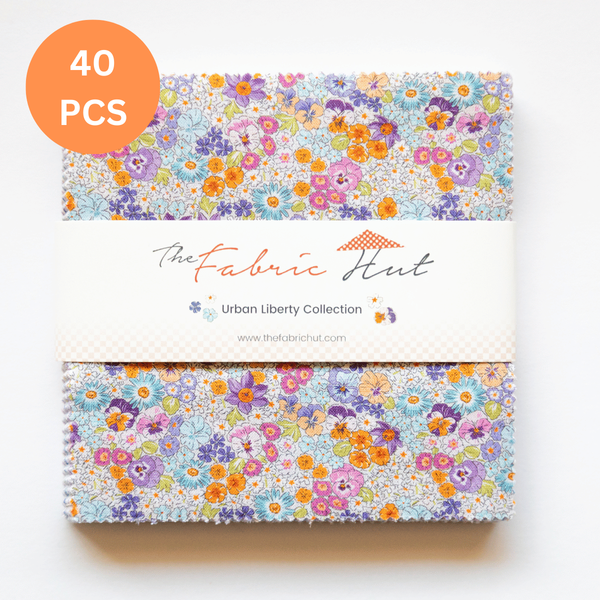
A template does one job. It marks the line where the rotary blade will pass and the fabric will be cut. A quarter of an inch inside that line runs a second edge, invisible and unmarked, where the needle will eventually travel and the seam will form. The first edge is where the fabric ends. The second is where the block ends, and the two are never in the same place.
The strip that lies between them, that quarter of an inch all the way round, is folded to the back when the seam is sewn and never seen again. Whatever of the print happened to sit in that band is gone from the finished block. Most of the time this costs nothing, because the outer margin of a piece is often quiet, a stretch of background or an unremarkable part of the pattern. The trouble begins when something you wanted sits exactly where the allowance will take it.
This is why placement has to be judged against the seam and not against the cut. The eye goes naturally to the edge of the template, because that edge is drawn and solid and the obvious thing to line a motif up against. Yet that edge is not where the block will end. Reading the piece as it will finish means picturing the seam sitting a little way in from the cut on every side, and asking what falls outside it.
Once you start looking at fabric this way, you see the losses before they happen. A print stops being a flat sheet to cut economically from. It becomes a picture with an outer band that will be folded away, and the whole question of placement turns on keeping what matters clear of that band.
Picture a motif you have centred by eye within the template, pleased with how neatly it sits. Centred to the cut line, its outer edges reach right to the rim of the piece, which means they reach into the allowance. Once the seams on either side are sewn, those edges fold quietly away, and the motif that looked whole on the cutting mat comes out cropped in the block, trimmed on the very sides you were most careful with.
Or picture a single figure, a bird or a flower head, set tidily in the middle of a piece with room all around it. It survives its own four seams intact, but where that piece joins its neighbour, the join eats into the space beside it, and part of what sat near that edge vanishes into the seam between the two. The remedy in both cases is the same, and it is undramatic. You shift the template across before you cut, moving the shape so the part you care about sits well inside the seam, and you accept that the offcut on the far side will be a little larger. The fabric you lose to that larger offcut is the price of the picture you keep.
- Read the stitching line, not the cut line: Judge where a motif sits against where the seam will fall, a quarter of an inch in from the template, rather than against the drawn edge you are cutting to. The cut edge tells you where the fabric stops. The seam tells you where the block stops, and only the second one shows.
- Look underneath before you commit: Lift the template once it is placed and look at what lies outside the seam line on every side. A motif can sit perfectly to the cut and still lose an edge to the allowance, and the only way to catch it is to check each side before the blade goes through.
- Accept the larger offcut: Moving the shape across to protect a motif leaves more fabric behind on the opposite side, and that is a fair exchange. Cutting to save every inch costs more than it saves when the print was the reason you chose the fabric, because a saved offcut is worth far less than a block worth looking at.
- Rotate the template on a directional print: On shapes that turn within the block, the motif has to be checked for direction at every cut, since a piece that reads upright in one position reads sideways in the next. Make the first piece with care, then keep it beside the mat as a reference so the ones that follow match it for both placement and direction.
If you would like to watch these placement decisions play out, this project is cut and assembled from the first piece to the last on video.
Fabric being measured is being read for its size. Fabric being placed is being read for its picture. These are two different acts, and a block asks for both, but they happen at different moments and answer different questions. The ruler settles how big. The template, held loose over the print before it is pinned down, settles what.
The block will come out the right dimensions either way, whether you gave the print a second thought or none at all. Its measurements do not depend on placement. Whether it is worth looking at, though, is decided in that quiet moment while the template still floats on the cloth and can slide an inch in any direction. Move it then, or leave the picture to chance. The seam will not ask twice.
(And when a print is the whole reason a quilt works, it is worth starting with one you love. Have a browse through The Fabric Hut and choose the fabrics whose pictures you will want to keep whole.)
Happy quilting!