Blackthorn looks like brickwork and sews like a straight seam.
That is the whole claim, and it is the kind of claim that deserves to be checked rather than believed. A brick quilt pattern that staggers white blocks and bands of print across seventy five inches ought to be fiddly. This one has ninety points in the entire quilt where anything has to meet, and inside a row there is nothing to line up at all.
It is a free pattern, designed by Marbelia, it finishes at 75 by 85 1/2 inches, and it is the third of our strip and charm quilts after Alder and Aspen. Same unit. Same single cut. What moved is where the turns happen.

Download the Blackthorn Brick Quilt Pattern
Eleven pages, free to print, use and teach. It has the fabric list, the cutting, the two rows, the assembly, the binding, and the same quilt worked out in five sizes from baby to queen.
Download the Blackthorn pattern PDF
Everything you need to make this quilt

Morning Mist + White Supreme Bundle 488pcs
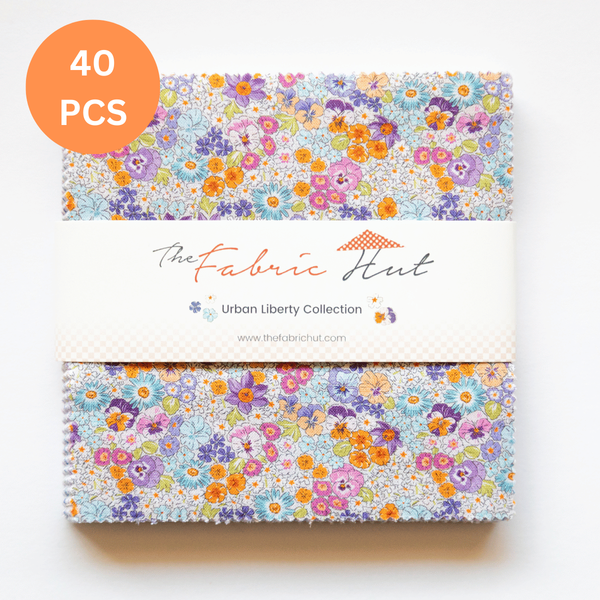
320 Precut Fabric Strips 2.5" x 10" + 168 Squares 5"
One Unit, Turned Two Ways, and Where the Brickwork Comes From
Here is the whole construction.
Take four mini strips, 2 1/2 by 10 inches, four different prints, and sew them along their long edges. That strip set measures 8 1/2 by 10. Cut it in half, five inches from either end, and you have two pieces of 8 1/2 by 5 that are identical twins. Sew a white 5 inch square to the short end of each one. The unit measures 13 by 5 unfinished and 12 1/2 by 4 1/2 finished.
That is it. There is one unit in this quilt and you make it a hundred and fourteen times.
Now the part that makes the brickwork. Lay six units in a row and turn every other one a half turn. The first has its strips on the left and its white square on the right, the second is reversed, and so on. What happens at the joins is that two white squares end up side by side and read as one white block of nine inches, and two bars of prints end up side by side and read as one band of sixteen.

The row below starts with the opposite one. So the nine inch whites and the sixteen inch bands trade places from row to row, and across nineteen rows they step past each other the way bricks do in a wall.
Nothing in that is a different unit. It is the same twelve and a half inch piece, turned.
Ninety Points, Not Five Hundred and Twenty Two
This is the number worth having, and it is the reason the quilt sews faster than it looks.
Inside a row there is nothing to match. The seams inside a unit run in the same direction as the seam that joins two units to each other, so they never cross. Even where two bars of prints sit side by side, their strip seams run parallel to the join and simply pass it.
The only places anything has to meet are the ends of the units on the seams between rows. There are five of those on each seam and eighteen seams. Ninety in the whole quilt.
Lay the same quilt out with every unit facing the same way and the arithmetic changes completely. Each unit then presents four strip seams to the row edge, six units give twenty four, plus the five unit joins, which is twenty nine on every seam. Across eighteen seams that is five hundred and twenty two points to match.
We worked both numbers out from the layout rather than taking them on trust, and they come to exactly what the pattern prints. The alternation is not a styling choice. It is the thing that removes four hundred and thirty two match points from an afternoon.
What You Need
Seven packs of mini strips, 2 1/2 by 10 inches, forty to a pack. The top takes 228 of them. Three packs of 5 inch white charm squares, 42 to a pack, and the top takes 114.
The binding comes out of the same seven packs as the top. Count the 228 strips for the quilt first, take 44 of what is left, and 8 strips are still over. That gives a scrappy binding carrying all twenty prints around the edge, which is what a quilt like this wants instead of a single fabric border.
Everything for the top and the binding is in one bundle of 488 pieces, which is 320 strips and 168 white squares. That is more than the pattern asks for on both counts, so there is margin if a strip set goes wrong.
Backing is 2 5/8 yards of 108 inch wide fabric, which gives 83 by 93 1/2 inches with no seam down the middle. Our guide to quilt backing works through why the wide stuff is worth it at this size. Batting is cut to the same measurement, four inches wider than the top on every side.
The One Cut, and When It Happens
Most quilts cut first and sew second. This one sews first.
There is a single cut in the entire pattern and it comes after the strip sets are made: each 8 1/2 by 10 set is cut once across the strips, five inches from either end. Nothing is trimmed before it and nothing is trimmed after it. The mini strips arrive at 2 1/2 by 10 and go into the machine as they are. The white squares arrive at 5 inches and go on as they are.
Which puts all the accuracy in one place: the quarter inch seam. Four strips sewn together have to measure 8 1/2 inches across. The pattern says to sew one strip set and measure it before sewing the other fifty six, and that is the single most useful sentence in it. If your set comes up short, the seam is too wide, and you will find out after one set instead of after fifty seven. Our walkthrough of setting and testing a quarter inch seam covers how to check yours.
Two more things the pattern asks for and both have a reason. Press the strip set seams open, and sew each seam in the opposite direction to the one before it, or the set will bow. Use a shorter stitch length than usual, because the set gets cut across and a short stitch holds the ends. Our notes on pressing for crisper blocks go through setting a seam before you open it.
A Hundred and Fourteen of Anything
There are 342 pieces in this quilt top and 398 seams. Nearly all of the sewing is the same two operations repeated: 171 seams making strip sets, and 114 seams putting a white square on a half set.
Which is what chain piecing was invented for. Feed the units through one behind the other without cutting the thread, then cut the chain apart at the end. Our guide to chain piecing has the setup, and on a run of 114 it is the difference between an afternoon and a weekend.
Keep the white square at the same end of every unit while you sew. The half turns happen later, when the units go into the rows, and a unit built the wrong way around is a unit you cannot turn into place.
How It Compares to Alder and Aspen
The three quilts share a unit, a cut and a seam allowance, and they are completely different from each other to sew.
In Alder a whole row faces one way and the next row faces the other. White squares meet bars of print along every row, so nothing lines up anywhere inside a row and there are 56 points to match in the quilt. It is the one to sew while thinking about something else.
In Aspen the rows are in phase and aligned, which is handsome and asks for 348 match points. It is the one that shows your quarter inch.
Blackthorn turns the units inside the row instead of turning the row, which gives you the staggered brick field and 90 points. It sits between its two brothers on effort and looks like the most work of the three.
Worth knowing if you are choosing: the throw size of Blackthorn in the five size table is 62 1/2 by 67 1/2 inches with 75 units and 38 strip sets, which is Alder exactly. Same dimensions, same piece count, same cutting. Only the turning differs.
Five Sizes, One Unit
The pattern works the same quilt out in five sizes and the unit never changes. Baby at 37 1/2 by 54, lap at 50 by 58 1/2, throw at 62 1/2 by 67 1/2, the twin shown here at 75 by 85 1/2, and queen at 87 1/2 by 94 1/2. Only the counts move.
We checked all five against the unit: every finished width is the number of units across times 12 1/2, every finished height is the number of rows times 4 1/2, and the strip set count is the units halved and rounded up, because an odd number of units leaves half a set over. All five close.
One note for anyone making the baby size. It is the only one of the five with an even number of rows, twelve, so it runs 6 A rows and 6 B rows and ends on a B. The instruction to start and end with a row that begins with the four strips is written for the twin and cannot hold on an even count. Nothing else changes.
If you are deciding which size to make, our quilt size chart has the mattress measurements and the drape arithmetic.
Laying It Out
This is the step that deserves a design wall and a photograph.
Move the units around until the two halves of a strip set are far apart and no two matching prints touch, either along a row or between two rows. With twenty prints spread over 228 strips, some will repeat more often than others, and spreading those repeats is the only aesthetic decision in the whole quilt.
One more thing to look at while you are there: the prints run up and down inside the bars. A print with a clear direction will show it, so turn the units around until you like what you see.
Then take the photograph before you sew. Every quilter who has skipped that step has rebuilt a row from memory at least once.
Binding, and Why It Is Four Lengths
The 44 binding strips go into four piles: two of 10 for the top and bottom, two of 12 for the sides. Each pile joins into one length, pressed in half along its length, and goes on with a 3/8 inch seam and a walking foot.
Press every join open. Pressing them open is what keeps the binding flat, because the layers end up spread out instead of stacked, and on a scrappy binding made of 44 short strips there are a lot of joins to stack.
The 3/8 inch seam is wider than the quarter inch you used on the top, and that is deliberate: a 2 1/2 inch binding needs the extra to sit full once it is rolled over the edge.
One Last Thing
I like this one because of what it does not ask for. No borders. No trimming. No blocks to square. One cut, made after the sewing, and a layout you work out on the wall rather than on paper.
What you get for that is a quilt that looks considerably harder than the afternoon it took, which is a trade I will make every time.
There are more of these in our free quilt patterns, and four more in this family still to come.
P.S. Open all seven packs together before you start. The binding comes out of what the top leaves behind, and counting the 228 first is what makes the numbers work.