Thirty-nine cuts give you seventy-eight blocks, and every one of them has a twin.
Hawthorn is a free quilt pattern that finishes at 58 1/2 by 75 inches. It is made from one unit, repeated seventy-eight times, and the only cut in the whole quilt happens after the sewing rather than before it. You sew four mini strips together, cut that piece of patchwork in half, and add a white square to each half. The rulers go back in the drawer after that.
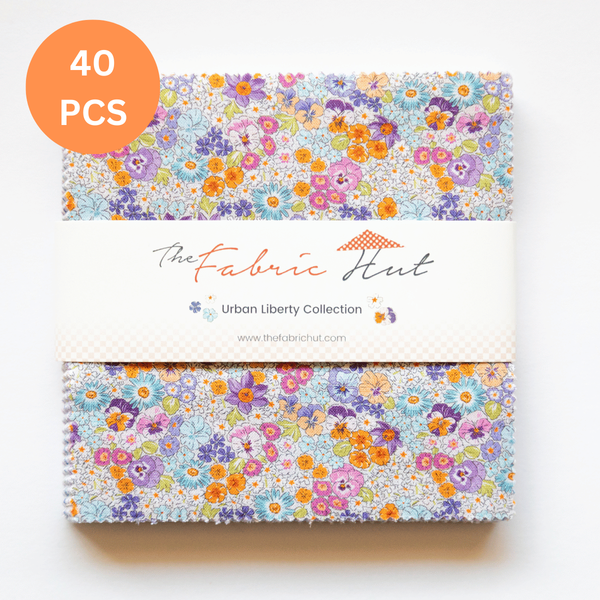
It was designed by Marbelia Fernandes, The Fabric Hut Co-Founder, and this version is made in Blossom Breeze, forty prints in pinks, aquas, teals and navy, with White Supreme squares between them.
Pattern details
- Pattern name: Hawthorn
- Designer: Marbelia Fernandes, The Fabric Hut Co-Founder
- Finished size: 58 1/2" x 75"
- Size category: Throw
- Difficulty: Beginner
- Block: Strip and charm unit, 12 1/2" x 4 1/2" finished, 78 of them set 13 across and 6 down
- Technique: Strip piecing, chain piecing, one cut
- Fabric: Blossom Breeze mini strips and White Supreme 5" squares
- Price: Free to print, use and teach from

Download the Hawthorn quilt pattern
Eleven pages, free to print, use and teach from. The fabric list, the one cut, the unit, the rows, the layout and the binding, plus the same quilt worked out in five sizes.
Download the free Hawthorn quilt pattern PDF
Everything you need to make this quilt

Blossom Breeze + White Supreme Bundle 284pcs
200 Precut Fabric Strips 2.5" x 10" + 84 Squares 5"
One unit, and the turn that makes the pattern
Take four mini strips, 2 1/2 by 10 inches, four different prints, and sew them along their long edges. That strip set measures 8 1/2 by 10. Cut it in half, five inches from either end, and you have two pieces that are identical twins. Sew a white 5 inch square to the short end of each one.
That is the whole unit, and you make it seventy-eight times.
Hawthorn stands the unit upright and alternates it column by column: the first column carries its white squares at the bottom, the next at the top, and so on across the thirteen columns. Where two columns meet, white sits against print all the way down, which is what draws the vertical line you see in the quilt.
Nothing is pieced to make that line. It is the same unit, turned.
What you need
Five packs of mini strips, 2 1/2 by 10 inches, forty to a pack. The top takes 156 of them. Two packs of 5 inch white charm squares, 42 to a pack, and the top takes 78.
The binding comes out of the same five packs. Count the 156 strips for the top first, take 38 more for the binding, and 6 strips are left in the bag. That gives a scrappy binding carrying prints from all over the quilt, which is what a quilt like this wants instead of a single fabric border.
Backing is 2 3/8 yards of 108 inch wide fabric, which gives 66 1/2 by 83 inches with no seam down the middle. Our guide to quilt backing works through why the wide stuff is worth it at this size. Batting is cut to the same measurement, four inches wider than the top on every side.
If you would rather pick the fabrics yourself, our precut mini strips and charm squares both work, as long as the squares are much lighter or much darker than every print you put beside them.
The one cut, and where the accuracy lives
Most quilts cut first and sew second. This one sews first. There is a single cut in the pattern and it comes after the strip sets are made: each 8 1/2 by 10 set is cut once across the strips, five inches from either end.
Which puts all the accuracy in one place, the quarter inch seam. Four strips sewn together have to measure 8 1/2 inches across. Sew one strip set and measure it before you sew the other thirty-eight, and you will find out after one set instead of after thirty-nine. Our walkthrough of setting and testing a quarter inch seam covers how to check yours.
Press the strip set seams open and sew each seam in the opposite direction to the one before it, or the set will bow. Use a shorter stitch length than usual, because the set gets cut across and a short stitch holds the ends.
Seventy-eight of the same thing
Nearly all of the sewing here is two operations repeated: 156 seams making strip sets, and 78 seams putting a white square on a half set. That is what chain piecing was invented for, and our guide to chain piecing has the setup.
Keep the white square at the same end of every unit while you sew. The half turns happen later, when the units go into the columns, and a unit built the wrong way around is a unit you cannot turn into place.
Laying it out
This is the step that deserves a design wall and a photograph. Move the units around until the two halves of a strip set are far apart and no two matching prints touch, either along a column or across to the next one. With forty prints in the box there is always a way to do it, and that is the one aesthetic decision in the whole quilt.
Then take the photograph before you sew. Every quilter who has skipped that step has rebuilt a row from memory at least once.
Where it sits among its brothers
Hawthorn is one of seven quilts built from the same unit. Alder lays the unit down and turns whole rows, which makes it the easiest of the family to sew. Aspen keeps every column in phase, so the strips line up in bands that cross the quilt. Blackthorn alternates inside the row as well as between rows, which is what gives it the brickwork.
Same unit, same single cut, four different quilts.
There are more of these in our free quilt patterns.
P.S. Open all five packs together before you start. The binding comes out of what the top leaves behind, and counting the 156 first is what makes the numbers work.