She bought a thousand zippers for five dollars.
A shop that sold tartans was closing them out at ten cents each, and there must have been a thousand of them in the bin. She asked what the whole lot would cost. Five dollars, and they were hers. For the next nine years, every student who came through her home economics class learned to set a lapped zipper out of that bucket.
Then she retired, and the bucket went down to the basement. So did the shiny scraps left over from the thirty kitchen witches she once made as props for a school play. So did the shoeboxes of ribbon rolls, the bag of lace, the roving from a weaving class, the orphan blocks that never became quilts. Twenty years in the same house, and some of those boxes had not been opened once.
It is July now. Outside, the heat presses down. Down in the sewing room it is cool, and every box is open.
Then a group of her friends started sewing fidget blankets, and everything on those shelves suddenly had a purpose.
If you have ever wondered how to make a fidget quilt, that is the honest starting point. Not a pattern. Not a shopping list. A pile of saved things and someone you want to comfort.
She filmed the whole build, and the most useful thing in it is the mistake she makes.
What is a fidget quilt, and is a fidget blanket the same thing?
A fidget quilt is a small lap quilt, mat or blanket that gives sensory and tactile stimulation to hands that will not settle. You will also hear it called a fidget blanket, a touch quilt, a fiddle quilt or a sensory activity blanket, and the Alzheimer Society describes exactly this kind of quilt as a way to comfort, calm and occupy people living with mid to late stage Alzheimer's disease and related dementias, as well as people with autism and developmental differences.
The construction is simple. Fabrics with different textures and colors are pieced side by side, then embellished with pockets, laces, trims, appliques, buttons, securely fastened beads, ribbons and braids. Nothing about it is precious. Everything about it is deliberate.
Why fidget quilts matter
Restless hands are not a nuisance to be corrected. They are usually a person telling you, in the only language still fully available to them, that they are anxious, or bored, or looking for something familiar to hold.
Sensory activities like these sit inside a wider approach to care that puts the person first. The Alzheimer Society of Canada is clear about the order of things: person-centered care first, and antipsychotic medication as a last resort for the behavioral and psychological symptoms of dementia.
Fidget blankets have been used in exactly that spirit. A student-led pharmacy outreach program handed them out to people with dementia as sensory stimulation, with one stated goal: less antipsychotic medication. That work was written up in The Consultant Pharmacist in 2016.
It is worth being honest about the evidence. The formal research base is small and mostly descriptive rather than conclusive. What is not in doubt is what caregivers report: a pair of hands that has something good to do is often a pair of hands that stops pulling at clothing, at bedding, at the IV line.
That is enough reason to sew one. Here is what it takes.
What you need to make a fidget quilt
Look in your scrap bins before you look anywhere else. A fidget quilt is one of the few projects that actively rewards a well-fed stash. That said, here is what earns its place:
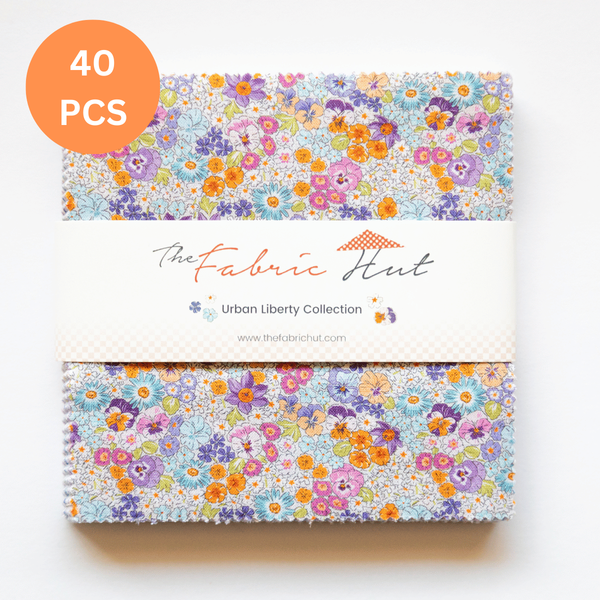
- A sturdy background. Quilting cotton works, and an orphan block you never finished works even better. Most stashes hold a lot of a few fabrics, and this project wants a little of many, so that is usually the gap. Precut 5" squares and fabric strips close it in one go: a stack of different prints, already cut, no yardage to break into.
- Texture, and plenty of it. Satin and shiny synthetics for slide and shine. Corduroy, fleece, wool and roving for grip. Home decor and upholstery weight fabric for body that survives handling.
- Contrast in color. Solid fabrics help the activities stand out instead of disappearing into a busy print. A busy print swallows a zipper. A solid frames it.
- Ribbon, lace, trim, shoelaces and cord. Anything that can be tugged, wound, threaded or stroked.
- Zippers, large buttons, buckles, hair elastics and big beads. The louder and more satisfying the action, the better.
- Interfacing or drapery stiffener to give flaps, doors and window shutters enough structure to stay open.
- Batting, backing and binding fabric.
- Strong thread. This quilt is going to be pulled at every day. Do not use the weakest spool in the drawer, and if the thread in your box is older than the quilt you are about to make, replace it.
- Sharp tools. A rotary cutter with a fresh blade, a ruler, and a set of basic notions.
That is the shopping. The building is eight steps, and the first one is the one people skip.
How to make a fidget quilt, step by step
1. Decide who the quilt is for
This is the step people skip, and it is the one that decides whether the quilt gets used or folded away. Ask the family or the care team. Was she a nurse, a gardener, a traveler? Does he still have the grip strength for a buckle, or is a zipper pull easier? Is there a country, a color, a season that means something?
In her case the theme arrived by accident. A Union Jack home decor fabric had been sitting in a cupboard since a trip to the UK, bought to cover a beanbag for a grandson named London. He never took to the beanbag. Red, white and blue chose themselves, and a whole quilt grew out of one saved memory.
2. Choose a lap-friendly size
Keep it small. Small enough to rest on a lap without sliding off, light enough to lift with one hand, easy to hold against the chest.
This is the mistake, and it is the one worth having somebody else make for you. The first quilt turned out too big for a lap. It had to be laid on a desktop or propped up on something, which quietly limits when and where a person can reach for it. Make the next one smaller. Make the first one smaller too.
3. Build a sturdy background
Piece a simple background from cotton, or repurpose an orphan block. Then think about weight. Everything you sew on top adds pull, and a floppy background will sag and distort within a week. Home decor and upholstery fabrics carry that load beautifully, which is why they keep appearing in fidget quilts.
4. Plan the activities before you sew anything
Lay every element on the background and move it around. A shiny cross of satin ribbon over a red bar. A row of prairie points, those folded fabric triangles, threaded onto a shoelace so they spin and hide small things behind them. A zipped pouch with felt motifs inside that pop out and dangle but stay tethered so they cannot be lost.
Leave breathing room. A fidget quilt that is crowded edge to edge gives the eye nowhere to rest, and a person who is already overwhelmed will push it away.
5. Add the border early
Attach your border before the bulky elements go on. This sounds like a detail. It is not. Once a stiffened telephone box or a padded pocket is in the way, the whole quilt starts wrestling with the machine every time you try to sew near an edge. Borders first saves an hour of frustration later.
6. Sew the activities down
Now the fun part. Six that worked, all of them repeatable with what is already in your stash:
- Window flaps. A double-decker bus with lift-up window shutters, each one hiding a picture underneath. Drapery stiffener gives the flaps enough spine to stay open.
- A moving figure. A bus driver built from two spools threaded on elastic, so he can be lifted and bounced. Long arms and legs that can be repositioned. A painted button for a face.
- A door that opens. A telephone box closed with a hair elastic looped over a button, with a small bird tucked inside as a reward for opening it.
- A zipped pocket. Everything inside stitched to a tether so it can come out but never go missing.
- Sound. Keys on a cord. Jingles matter more than you expect.
- Texture pairs. Two different trims sewn on either side of a pocket, so one hand finds shine and the other finds fuzz.
Stitch everything with strong thread and go over it more than once. If you are attaching buttons by hand, self-threading needles make repeated passes far less tedious.
7. Quilt, back and bind
Layer with batting and backing, quilt through the open areas so the layers stay together, then bind the edges. Choose a soft backing. The quilt will spend a lot of time face down on a lap, and the underside is touching skin.
If binding is the part you are least sure about, our full quilt binding tutorial walks through it from start to finish.
8. Run the safety check
Test this quilt as though it will be handled by somebody who has no idea it is fragile, because that is exactly who is going to handle it. Pull on every single thing you attached. Buttons, beads, ribbon ends, buckles, the lot. Tug harder than you think is fair. Anything that gives is a choking hazard, and it needs to be resewn or removed.
Then check the fastenings for the opposite failure. A latch or a stiff clasp can be genuinely satisfying, and it can also defeat someone with arthritis or Parkinson's and turn a comfort object into a source of failure. When in doubt, choose the easier version.
Then run the list below, out loud, with the quilt in your hands.
A short safety checklist
- Nothing comes off under a firm tug.
- No small loose parts. Anything removable is tethered.
- No cords long enough to wrap around a neck or wrist.
- Fastenings are openable by the person who will use it, not just by you.
- Nothing sharp, nothing that will rust, nothing that will melt in a warm wash.
- The care team has seen it and approved it.
Making the second one better
Every maker in this craft says a version of the same thing after the first attempt: smaller, more movement, more hidden things. More slide, more shine, more texture, more flaps that open onto something worth finding. If what you want next is a different project entirely, our free quilt patterns are there for that.
The first one teaches you. The second one is for them.
Frequently asked questions
What is a fidget quilt used for?
It gives restless hands something purposeful to do. Most are made for people living with dementia, and many are made for children and adults with autism or ADHD who benefit from tactile input.
Is a fidget blanket the same as a fidget quilt?
Yes. The two names describe the same object, and which one you hear depends on who is talking. Care homes and dementia charities tend to say fidget blanket, or sometimes twiddle blanket. Quilters tend to say fidget quilt, because they are quilting one. Nothing about the construction or the safety rules changes with the name.
How big should a fidget quilt be?
Small enough to sit on a lap without sliding off, and light enough to lift with one hand. If it needs a table to stay put, it is too big.
What fabrics work best for a fidget quilt?
Mixed ones. What matters is contrast under the hand, not a coordinated palette: something that slides, something that grips, something with weight. Quilting cotton for the background, satin and shiny synthetics for slide, corduroy, fleece and wool for grip, and home decor or upholstery weight wherever the pulling will happen.
How long does it take to make one?
A weekend is realistic for a first quilt if you already have your fabrics and trims sorted. The sewing is quick. The planning is what takes the time.
Can I use scraps and leftovers?
Yes, and you should. Fidget quilts are the best possible home for orphan blocks, odd trims, single buttons and fabrics you have carried around for years without a project. The one thing a stash rarely supplies is variety in small amounts, which is what the materials list above is for.
Are fidget quilts safe for people with dementia?
They are when two things are true. Every element is sewn down firmly enough that it cannot be pulled off, because loose buttons and beads are a choking risk. And every fastening can actually be opened by the person using it, because a clasp too stiff for arthritic hands is a different kind of harm. Check both yourself, then check with the care team.
Should the quilt be washable?
Plan for it from the beginning. Pick trims and fastenings that survive a gentle cycle, and confirm the laundry rules with the family or the care home before you hand it over.
Where can I donate a finished fidget quilt?
Local memory care homes, hospital dementia wards, hospice programs and Alzheimer Society branches often accept them. Ask about their safety requirements first, because some facilities have their own rules about attachments and washing.
Start with what you already have
A thousand zippers bought for five dollars. Ribbon rolls in shoeboxes. Shiny scraps left over from kitchen witches made for a school play. None of it was saved with a plan. All of it turned into comfort for somebody's hands.
You almost certainly have the beginning of a fidget quilt in your sewing room right now. The one gap a stash rarely fills is variety in small amounts, and a pack of precut charm squares puts a whole stack of different fabrics on your table without a single cut.