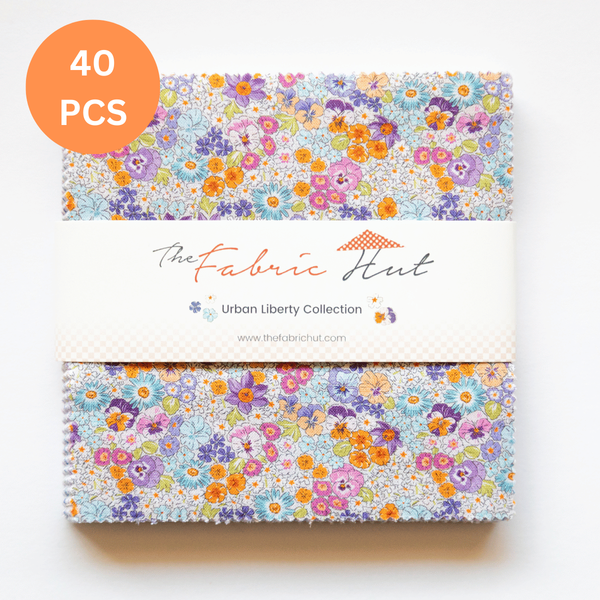
Twelve free throw quilt patterns for beginners, and every one of them starts from a precut, so a charm pack or a bundle of mini strips takes care of most of the cutting.
All twelve are ours, designed by Marbelia Fernandes, The Fabric Hut Co-Founder, and every PDF is free to print, use and teach from. By finished size, the smallest is 56 by 60 inches and the longest 58 1/2 by 75. Five of them are made from 5 inch charm squares and have no cutting at all. The other seven have exactly one cut each.
They fall into three families, grouped by the precut they use, so you can start from whatever is already on your shelf.
- Charm square throw quilts, five patterns
- A mini strip throw quilt, one pattern in three colorways
- Strip and charm throw quilts, six patterns from one unit
Charm square throw quilts
Five patterns, 208 charm squares each, thirteen across and sixteen down, for a throw of 58 1/2 by 72 inches. The squares go into the quilt exactly as they come out of the charm pack. Three are color runs in Canvas by Northcott and two are checkerboards.
Sumac

A single peak of color in the middle column, falling away on both sides. Every column holds the same run of colors in the same order, and the run starts one square higher in each column as you work out from the center. The pattern draws the whole quilt square by square, with a pile number in every cell, so you copy the map instead of counting. Sumac is symmetrical, which makes it the easiest of the three color runs to check as you go.
Bracken

The same color run as Sumac, with the start point moving further each time. The color rises, falls and rises again, two waves across the width where Sumac has one peak. On a bed it holds up better, because a single peak wants to be seen whole and a bed folds the middle away.
Larkspur

One long soft wave that rises and falls once across the quilt. The shift from one column to the next is small, often zero, so Larkspur reads more like a gradient than a pattern. It puts the color run itself on show, which is why it looks best in colors that sit close together: all the blues and teals, or the warm half of the rainbow.
Juniper

A checkerboard from two collections. Patchwork Carnival is the loud one, forty prints of checks, stripes, stars and dots. Morning Mist is the quiet one, twenty prints in mossy greens and soft beiges. Alternate them square by square and the eye gets somewhere to rest between every bright square. The pattern is rated confident beginner.
Holly

A checkerboard from one collection, Snowman & Snowflake, where all twelve prints are some shade of winter blue. The two halves of the board cannot come from color, so they come from value: six pale prints against six deeper ones. Sort the charms by how dark they are, not by the pictures on them.
A mini strip throw quilt
Cherry Blossom

Sixty blocks, four across and fifteen down, finishing at 56 by 60 inches. Each block is two mini strips and a white square trimmed to 5 by 4 1/2 inches, and that trim is the only cutting in the quilt. There is not a single point to match. It was drawn for Blossom Breeze, forty florals in pink and aqua, and it comes in two more colorways: Morning Mist, where twenty greens each turn up six times, and Patchwork Carnival, forty bright prints that turn it into a fairground.
Strip and charm throw quilts
Six patterns from one unit. Four mini strips are sewn together along their 10 inch sides, the strip set is cut in half, and a 5 inch white square goes on each half. That cut is the only one in the quilt, and it happens after the sewing. What changes from one pattern to the next is how the unit is turned and set. Every one of the six comes in Blossom Breeze and Patchwork Carnival, and Alder and Aspen come in Morning Mist as well.
Alder

The unit lies on its side, 12 1/2 by 4 1/2 inches, and the rows alternate. Inside a row a white square always meets a bar of prints, so there is nothing to line up. In the whole top only 56 points have to match, all of them on the fourteen long seams where one row meets the next. Alder finishes at 62 1/2 by 67 1/2 inches, in Morning Mist, Blossom Breeze and Patchwork Carnival.
Hazel

Nothing in this quilt is turned. Every unit goes in the same way up, and the last row leaves its white square off, so the quilt ends on color the way it began. Hazel finishes at 58 1/2 by 70 1/2 inches, in Blossom Breeze and Patchwork Carnival.
Aspen

Every column is in phase, so the strips line up in bands of print that cross the whole quilt, with rows of white between them. Six rows of thirteen units, 58 1/2 by 75 inches. The seams run unbroken across the full width, which makes a quarter inch seam that holds steady the one thing to get right. Made in Morning Mist, Blossom Breeze and Patchwork Carnival.
Rowan

A mirror. Sew three rows, sew them again the other way up, and where the two halves meet they open into a band of white nine inches deep. Rowan finishes at 58 1/2 by 75 inches, in Blossom Breeze and Patchwork Carnival.
Hawthorn

The unit stands upright and alternates column by column, thirteen columns of six. Thirty-nine strip sets, each cut in half after sewing, give you seventy-eight units, and every one of them has a twin somewhere in the quilt. Hawthorn finishes at 58 1/2 by 75 inches, in Blossom Breeze and Patchwork Carnival.
Dogwood

Turn every other unit upside down and a lattice appears that is not in the block you sew. Two white squares meet and read as a tall window, two bands of print meet and read as a bar across it. Seventy-eight units, 58 1/2 by 75 inches, in Blossom Breeze and Patchwork Carnival.
Which one to make first
If this is your first quilt, start with Holly or Cherry Blossom. Holly has no cutting at all and a layout you can see while you work. Cherry Blossom has one trim per block and nothing to match.
If you have made a quilt or two and want the most quilt for the least matching, make Alder. If color interests you more than piecing, make one of the color runs. They are sewn exactly like a checkerboard, square to square in straight columns, and they look nothing like one.
The three color runs take seven packs of Canvas, 42 squares to a pack. That is 294 squares for a quilt that uses 208, so you finish with 86 spares for the next project.
Do these free quilt patterns cost anything?
No. Each pattern page has the PDF to download, with no sign-up in the way, and you are welcome to print it, sew from it and teach from it. The fabric for each quilt is also counted out as a precut-friendly kit, and you will find it on the pattern page if you would rather not count packs yourself.
When you finish one, I would love to see it. Send it to marbelia@thefabrichut.com, or post it on Facebook or Instagram with #TFHCreations. There are more designs, ours and other designers', in our free quilt patterns.